


Publishing a great blog is not enough anymore. What’s the point if your blog is really well written but no one sees it seems like a waste of talent to me. This is why in this blog, I am breaking down the 5 most effective strategies to increase your blog traffic. These are repeatable tactics that you can implement on your blog to attract the right visitors and keep them coming back to your blog.
Whether you’re running an affiliate site, managing a brand blog, or writing for your clients, attracting more readers to your content is what drives more revenue, leads, and long-term growth. Here’s how to make it happen.
Table of Contents
| 1. Why Your Blog Is Not Getting Traffic |
| 2. On-Page SEO Strategies for Blogs |
| 3. Off-Page SEO Techniques |
| 4. Improving Blog Authority and DA |
| 5. Promote every blog post via email |
| 6. Keyword Research and Content Optimization |
| 7. Frequently Asked Questions |
| 8. Final thoughts |
1. Why Your Blog Is Not Getting Traffic
Many Bloggers write really high quality article yet they struggle to increase their blog traffic. There can be several reasons why your blog is not receiving much traffic.
Common reasons include:
Thin content:
Short articles rank very poorly on search results. Try to write your blog at least 1000 to 1200 words without compromising the quality of your content. Instead of writing two short 600-word articles, focus on writing one high-quality 1200-word article. It would rank fairly easily compared to a short article.
Tip: Use our word counter tool for accurate results.
No keyword targeting:
Another common mistake that beginners make is that they do not target any relevant keywords while writing a blog. Writing without focusing on search intent limits visibility on search engines.
Poor internal linking:
Internal linking means connecting different pages within the same website using hyperlinks. Poor internal linking causes your visitors to leave your blog without exploring more pages.
Low promotion:
Not sharing posts on social media and communities would reduce the number of visitors you would get on your blog.
Slow website speed:
If your website’s speed is really slow, the visitor will lose interest and leave your blog without exploring any pages. So try to keep your website’s interface fast and user-friendly.
If you fix all these issues, your chances of getting more visitors will improve significantly.
2. On-Page SEO Strategies for Blogs
On-page SEO helps search engines to understand your content better and helps to rank it on SERP (Search Engine Result Page). Better On-page SEO means more visibility on Search Engines.
Write clear, keyword-focused blog titles.
The first thing that grabs your attention is the blog title. Whether you are browsing on Google or scrolling on social media. If it does not grab the attention of people, it will not get clicked, no matter how good it is.
The best blog post titles are:
- Describes the topic clearly.
- includes the primary keyword naturally.
- Specific and results-oriented.
Avoid clickbait. Focus on clarity and search intent for the best user experience.
Tip: Place your primary keyword near the beginning of the title when possible, but only if it still sounds natural.
Examples that work:
- Doesn’t work: “How to increase your blog traffic.”
- Does work: “6 proven strategies to increase your blog traffic in 2026 ”
The second example tells you what, how much, and why you should care, all in one line.
Tip: Write 3–5 variations of every headline before picking one. A strong title can double your traffic on its own.
Use SEO-Friendly Headings
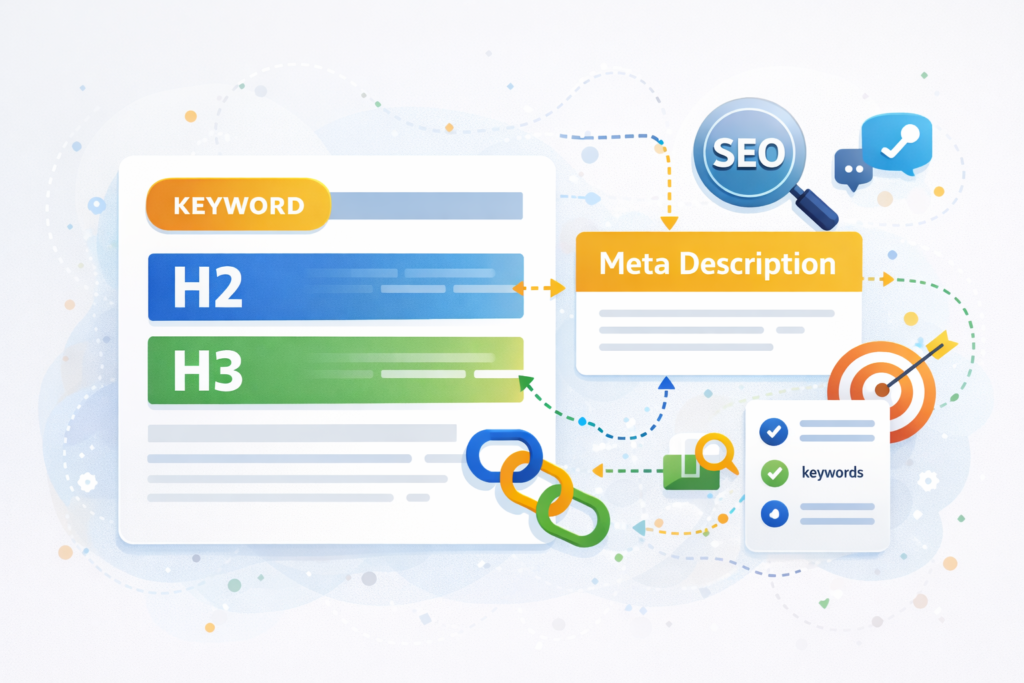
Headings help to structure your content and make it easier to read. Using H2 and H3 headings allows search engines to understand your content and helps in ranking your article.
Each heading should:
- Describe the section clearly.
- Include related keywords naturally.
This improves readability and helps in ranking.
Tip: If a heading doesn’t make sense on its own, rewrite it until it clearly explains what the section is about.
Strengthen your internal linking
Internal linking helps distribute authority across your website, and it encourages visitors to explore more pages rather than leaving your website after reading only one article. It also helps search engines understand how your content is connected.
Best practices:
- Link only to relevant and helpful articles.
- Use descriptive anchor text instead of generic phrases.
- Avoid adding too many links in a single paragraph.
Tip: When publishing a new post, go back to older articles and add links pointing to it if it’s relevant.evant.
3. Off-Page SEO Techniques
Off-page SEO focuses on actions that are taken outside your website, which help in building trust, authority, and credibility. Strong off-page SEO signals the search engines that your content is worthy of showing up in search results.
Build High-Quality Backlinks
Backlinks are one of the most important ranking signals in SEO. When very reputable websites link to your blog, it helps build trust for your blog in the eyes of search engines.
Instead of building hundreds of low-quality backlinks, build some high-quality backlinks relevant to the niche and topic of your website.
Effective methods include:
- Guest posting: Write high-quality content for other blogs and link them to your site naturally.
- Blogger outreach: Reach out to website owners to reference your content.
- Resource link building: Create useful resources that naturally earn links from other websites.
Quality matters far more than quantity. A few strong backlinks from trusted sites can outperform dozens of weak ones.
Tip: Always link back to a specific, helpful, and relevant page on your blog instead of your homepage.ost.
4. How to Improve Blog Authority and Domain Authority (DA)
Blog authority and domain authority grow when the search engines see your website as trustworthy and reliable. DA is not a direct ranking factor, but it is an indicator of how strong and trustworthy your site is compared to your competitors.
Increasing authority is a lengthy process, but it pays off in the long term. Consistent effort matters more than shortcuts.
To improve DA:
- Publish evergreen content.
- Earn backlinks from relevant sites.
- Maintain a clean site structure.
- Avoid spammy links.
Tip: Avoid buying links or participating in link schemes. Spammy links can decrease your domain authority instead of increasing it.
5. Promote every blog post via email
Promoting your blog post through email is one of the best ways to increase your blog traffic. its the audience that you own Unlike social media or search engines theres no algorithm getting in your way.
Every time you publish a new blog post, share it with your email list through email marketing platforms. You have already caught the attention of the readers; just use it to keep them coming back.
Here’s how to do it:
- Include a short description and link in your newsletter.
- Repurpose your old evergreen content and label it as an ongoing content series.
- Add blog posts to the automated welcome sequences.
For example, a simple email could say:
“We just updated our guide on 7 proven strategies to increase your blog traffic in 2026. Here’s what’s working right now.”
Helpful tools:
- Mailchimp Free email marketing platform.
- MailerLite Great for cheap automation.
- Brevo Powerful free tier with visual builders.
Tip: Use UTM links when sharing your blog post via email so that you can track how much traffic you are receiving from each email in Google Analytics.u can track how much traffic you are receiving from each email in google analytics.
6. Keyword Research and Content Optimization
One of the most important SEO tactics is doing keyword research. Not only does this help in suggesting your content to the right audience, but it also helps in ranking your content on the results page.
If you do not do any keyword research related to your topic, you will most likely not receive any traffic, so keep keyword research as your top priority when writing an article.
Here’s how to do it:
- Focus on long-tail keywords: Long-tail keywords are very specific keywords that have really low competition and convert extremely well compared to broad keywords.
- Match search intent: Make sure that your content is about what your audience is expecting to see.
- Update old posts regularly: Refreshing your content with new data and keywords can improve its performance, and it saves time in comparison to writing new ones.
- Create content clusters around main topics: Organize related articles around your main topic to strengthen Blog authority and improve internal linking.
Your old evergreen content will perform really well over time if you do all these things.
Helpful tools:
- Google Search Console: Find keywords on which you rank and redo them.
- Ahrefs / Ubersuggest: Discover new, useful keyword ideas and competition.
- Surfer SEO: Optimize your structure, headings, and keyword placement.
Bonus tip: Try to use your focus keyword (like “SEO checklist”) early in your post, in your title, URL and meta description if it fits well, no need to stuff.
Frequently Asked Questions
Do I need traffic to get AdSense approval?
No. Google only checks content quality not its traffic volume.
How long does SEO take to work?
SEO usually takes 3–6 months for noticeable results.
Can a new blog rank without backlinks?
Yes, for low-competition keywords, but backlinks help growth.
Final thoughts
You don’t need to try all the strategies I told you. Instead, try one or two strategies at a time and see the results. What’s best for you, and build from there.
Let’s recap the core strategies:
- Focus on SEO and long-form content
- Jump on trends early
- Write irresistible headlines
- Repurpose for more reach
- Use your email list
- Guest post strategically
- Link internally
- Share on social media
- Keep your site user-friendly
Tip: Consistency is the key here writing great blog posts sharing them analyze the results do this over and over again to improve drastically.
Pingback: How Long Does SEO Take for a New Blog? (Realistic Timeline Explained) – rankifyo