
If you just started a new blog you probably would have heard about SEO but you would be wondering: how long does SEO take for a new blog? You may have published a few posts already and waiting for the traffic to come.
The short answer to that is: SEO takes time, In most cases your posts are not going to get decent traffic overnight if you made a new blog. According to my personal experience, you’ll start seeing noticeable results in at least 3 to 6 months.
In this guide, I’ll tell you exactly how long SEO takes for a new blog, what happens at each stage, how you can speed up results without using risky shortcuts and share my experience as a blogger.
Pro Tip: Remember, For SEO success, you always want to aim for long-term results. Don’t focus on risky shortcuts and put all your effort into achieving long-term results.
Table Of Content
| 1. How Long Does SEO Actually Take? |
| 2. Typical SEO Timeline For New Blog |
| 3. Why SEO Takes Time for New Blogs |
| 4. Can New Blogs Rank Without Backlinks? |
| 5. New Blog SEO Strategy That Speeds Results |
| 6. Frequently Asked Questions |
| 7. Conclusion |
1. How Long Does SEO Actually Take?
For the sake of a concrete answer, I’ll say that a with a fully SEO optimized blog, putting in consistent effort it would roughly take around 5 to 6 months to start seeing results. you may see results sooner than this (Some bloggers claim they started to see results in just over a month) or the process could even take years depending on your niche, which is actually insane.
The bloggers can claim whatever, The truth is that SEO takes a lot of time search engines are not like some social media platform where your video can go viral even overnight, but instead it requires you to continuously analyze your data, see what works for you and expanding on it.
If you prioritize speed over sustainability , those tactics would end up hurting you. Google gets suspicious if there’s a sudden increase in your ranking, as it’s assumed that some shady tactics have been used to achieve it.
You should consider that there a lot of factors that can affect your SEO results in making them better or in cases making them worse. The time it takes to see results usually depends on things like the age of your website or the DA (domain authority) of your website.
2. Typical SEO Timeline For New Blog
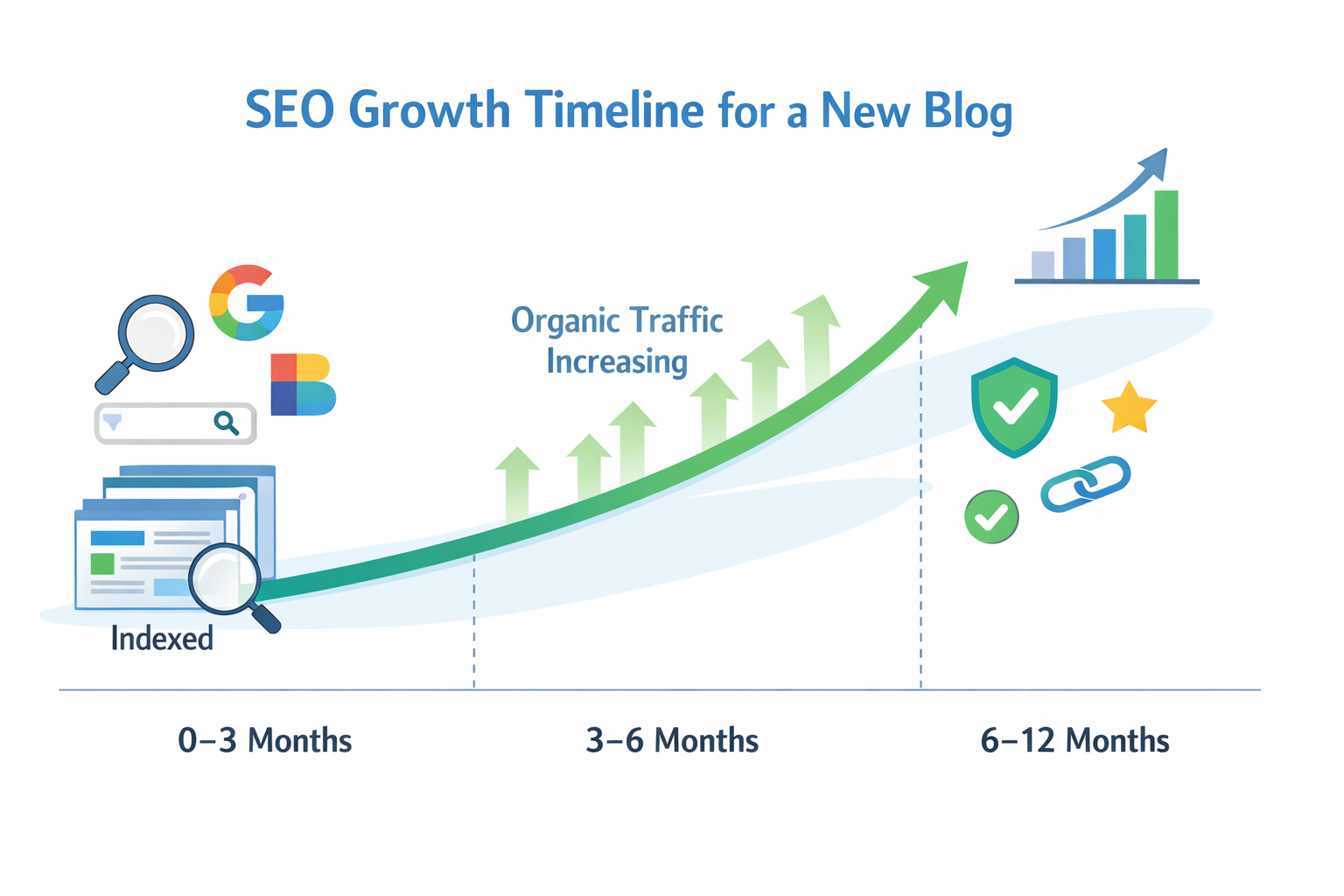
Every strategy or tactic has a different timeline but here is a typical timeline you should expect for SEO results.
Initial Phase (0-3 Months): Indexing and Discovery
In this beginning phase, you should focus on making a user-friendly and brandy website then start indexing and keep on publishing content on your site. The first 3 months is all about testing, Publishing content on your site, Analyzing what gained you attraction and just keep experimenting to find out what works and then expanding on it.
In this stage:
- your pages and posts will get indexed
- you start to see some impressions in your google search console
- Goggle starts to understand your website
- Traffic is really low in most cases or even zero
This period is completely normal. Most bloggers would be worried because they would not see much results which is completely normal for a beginner, I was also worried when I just started my journey as a blogger whether I would get any results or not, keep in mind that it is rare to see results in the first 3 months of starting a blog.
If you’re new to blogging and don’t have much knowledge about SEO and you’re wondering how do i increase my blog traffic, then you can check out my guide in which i discuss strategies on how you can increase your blog traffic
6 Proven Ways to Increase blog Traffic in 2026
Pro tip: Focus on publishing high-quality content and ensure proper indexing, forget about the traffic numbers.
Helpful tools:
- Google Search Console: It is used for indexing, to see impressions and get early SEO signals (most important tool)
- Google Analytics : It is used to track visits, see where visitors came from and understand which pages people visit first (Highly recommended)
- Bing Webmaster Tools: It provides you extra indexing outside of Google (Bing, Yahoo) (Recommended)
If you are a beginner these tools are very important for you, content indexing time can take over a week after your website is fully indexed on search engines, It takes time because of search engines crawling new sites so you might not get SEO results in 3 months but don’t get demotivated and put in the effort.
Pro tip: Focus on getting your site indexed and proper SEO and don’t worry about the low traffic.
Mid-term phase (3-6 months)
This is the phase where your site has been discovered by the search engines and you start to rank on keywords and start getting traffic on your site.
In this stage:
- you start to rank on long tail keywords
- your site authority starts to increase
- your brand gets recognized by some people
In this stage you start to see the fruit of effort you put in the first 3 months and start to see SEO results for new websites. Even though, you might not get crazy SEO results in 6 months but it gets you really motivated to work even harder.
Long-term phase (6-12 months)
In this phase you start to get really good flow of organic traffic to your website. Your start to rank on even difficult keywords which was once impossible to rank on a new website and the authority of your website will increase a lot.
In this stage, you will see:
- stable rankings
- traffic growth
- brand gets recognized
- High DA authority
There is not much to do at this stage other than what you have been doing for a while. At this stage people will start approaching you for guest posting, collaborations and many more exciting opportunities which you do not want to miss at all.
3. Why SEO Takes Time for New Blogs
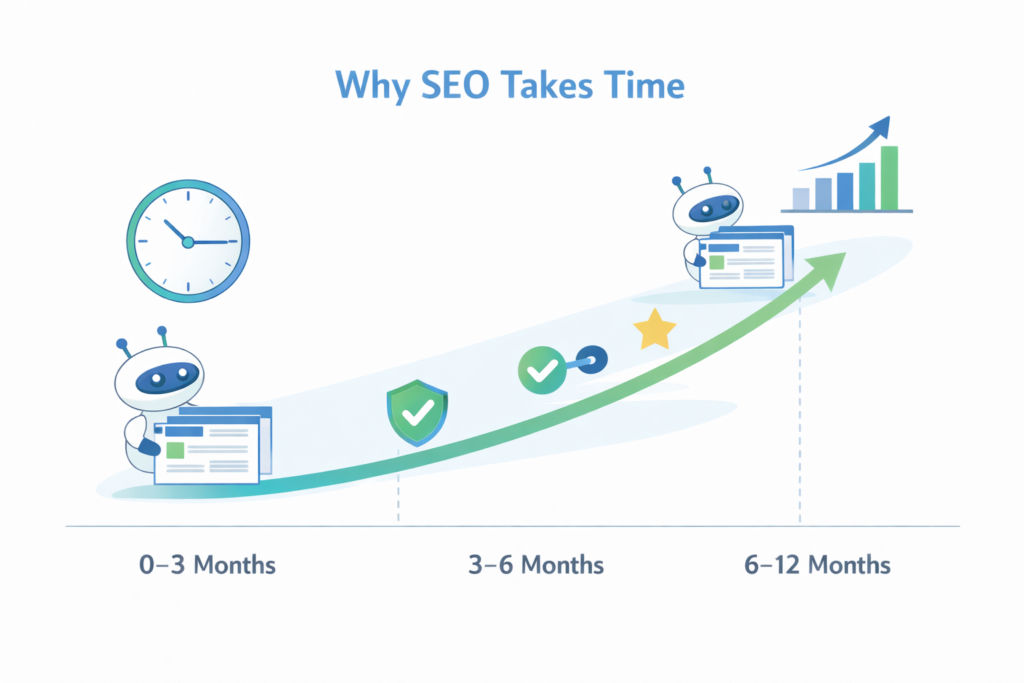
SEO results are not instant, especially for new blogs because the search engines are trying to understand your website and your website is getting indexed at the time.
New websites lack strong trust signals such as Backlinks, what this means is that no trusted site is linking to your blog. which means your Domain authority is very low and you also don’t have much user engagement and historical data.
If you don’t have much backlinks, user engagement and historical data then Google places your website in content evaluation period which is often referred to as the Google sandbox for new websites.
In early stages , Google usually tests your content by limiting your keywords and then analyzing how the users interact to your content. That is why it’s really important to put as much effort as possible in the quality of your content.
Pro tip: At early stages analyze your website and constantly do improvements to your website.
4. Can a New Blog Rank Without Backlinks?
Yes, a new blog can rank without backlinks, but it is possible if you target long-tail keywords instead of short competitive keywords where many major websites are already competing for a spot.
For example: It is easier to rank on “Best affordable laptops in USA” than “affordable laptops“.
If your content matches the search intent of the users and answers the query better than your competitors then there are high chances that your content can rank on Google even on a fresh domain. This proves that SEO does work for new blogs, but it is only possible with your consistent effort and time.
Internal linking is also very important for a fresh site. It can help Google to understand the purpose and structure of your website and it keeps your users engaged.
That said, backlinks are very important for your website, If you have a fresh blog you need to start working on earning them gradually, this may not affect your growth right now, but it helps a lot long-term.
5. New Blog SEO Strategy That Speeds Results
If you have a new blog and want to speed up your results, you should focus on simple and repeatable actions instead of shortcuts. If you have a good SEO strategy you can achieve good results even on a fresh website.
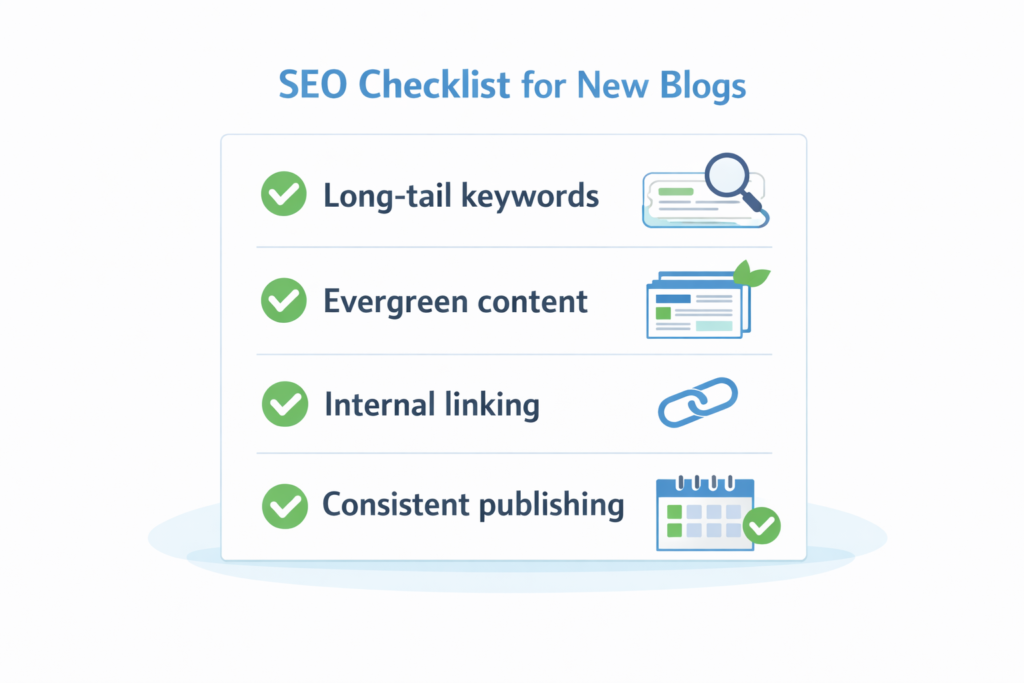
Focus on these proven tactics:
- Target long-tail keywords
Long-tail keywords have lower competition and are easier for new blogs to rank for. They can also attract more relevant visitors who are searching for specific answers. - Create evergreen content
Evergreen articles can stay relevant over time and continue to bring traffic months after publishing. These articles are really helpful for long-term growth. - Use strong internal linking
Linking related posts together helps search engines to understand your website’s structure and keep your visitors to stay on website for longer time period. - Publish consistently
Consistent publishing plays a huge role if you want to see results. It helps in improving your website’s readability and authority.
Pro tip: You don’t need to apply all strategies at once. You can start with one strategy at a time see what get results and expand it from there.
Frequently Asked Questions
How long does Google take to rank a new site?
Google can index a new website within days, but ranking a website takes time and consistent effort.
Does SEO work for new blogs?
Yes. SEO works very well for new blogs if done correctly.
Can I get traffic in 3 months?
Yes, especially for low-competition keywords, but high traffic is rare at this stage.
Is SEO worth it for beginners?
Absolutely. SEO is one of the best long-term traffic sources for beginners.
Final Thoughts
So, how long does SEO take for new blogs?
For most websites, expect 3–6 months for early results and 6–12 months for consistent growth.
You don’t need to rush or use shortcuts. Instead:
- Focus on quality content (1200-1800 words)
- Do proper SEO
- Stay consistent
- Track progress in Google analytics
- Analyze your data in Google analytics
- Improve based on data
SEO is a long-term strategy, but if you do it correctly it is absolutely worth it.