

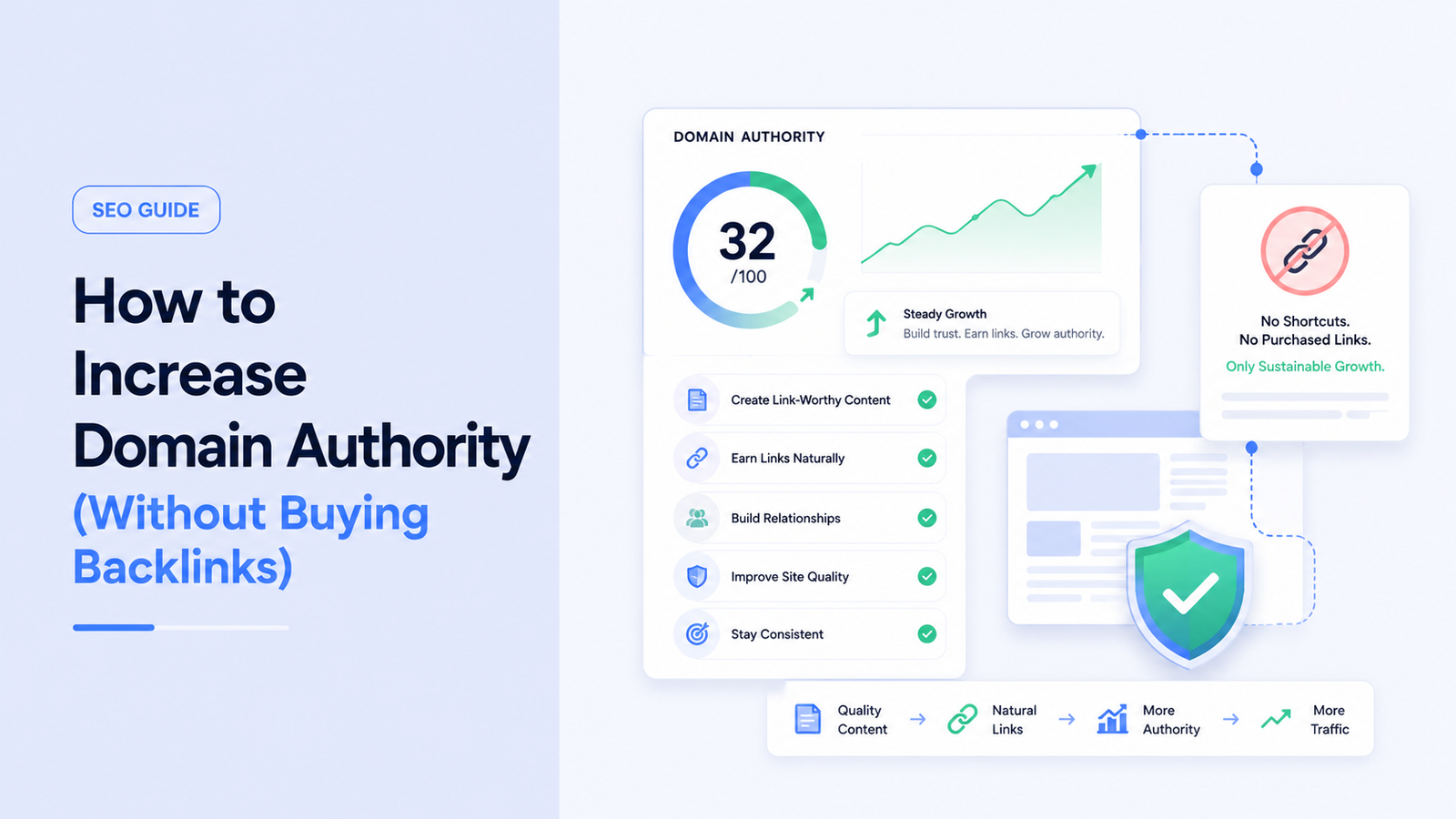
A few years into running my blog, I got an email pitch that felt like it was written specifically to target my insecurities.
Subject line: “Boost Your Domain Authority to 40+ in 30 Days — Guaranteed.”
My DA at the time, checked through the free MozBar extension, sat at a sad little 12. I’d been writing for over a year, and seeing that number just sitting there, barely moving, felt discouraging in a way traffic numbers somehow didn’t.
So I paid. $80 for a “link building package” from a site I found through a quick Fiverr search.
Thirty days later, my DA had actually gone up, to around 19. I felt briefly thrilled. Then, about two months after that, my actual organic traffic dropped, and when I checked Google Search Console, I had a message about “unnatural links” pointing to my site.
That’s the story of how I learned, the expensive way, what Domain Authority actually is, and more importantly, what it isn’t.
Quick Reality Check: DA Is Not a Google Ranking Factor
I need to say this clearly, because a lot of content online blurs this line, and I don’t want to add to that confusion.
Domain Authority (DA) is a metric created by Moz. It’s not something Google uses, calculates, or even acknowledges. Google has said this directly, multiple times, over the years.
So why does everyone talk about it like it matters?
Because it’s a genuinely useful proxy — a rough, third-party estimate of how strong and trustworthy your backlink profile looks, on a 1 to 100 logarithmic scale. It’s commonly used in outreach, guest posting decisions, and link-selling marketplaces as a quick way to gauge a site’s general “weight,” even though it’s not what actually moves your rankings.
Ahrefs has their own similar version called Domain Rating (DR). Semrush has an “Authority Score.” They’re all built differently, using different backlink data, so a site can have a DA of 30 on Moz and a DR of 45 on Ahrefs. Neither number is “wrong” — they’re just different companies measuring similar ideas with their own formulas.
Once that clicked for me, I stopped treating the number itself as the goal, and started treating it as a rough symptom of whether my actual link-earning efforts were working.
What Actually Happened With Those Purchased Links
Out of curiosity (and mild embarrassment), I eventually checked what that $80 package had actually built. Using Moz’s Link Explorer, I found a pile of low-quality links from:
- Random directory sites with no real traffic
- A few blog comment sections stuffed with links
- Some kind of private blog network with oddly similar-looking sites
None of it was from anything a real reader would ever visit. It boosted the number superficially, then triggered exactly the kind of red flag Google’s algorithms are designed to catch.
How I Cleaned It Up
- Exported the full backlink list from Google Search Console under the Links report
- Cross-checked it against Moz Link Explorer to identify the obviously spammy ones
- Built a disavow file (a simple text file listing the domains to disavow, one per line with “domain:” in front)
- Submitted it through Google’s Disavow Tool inside Search Console
- Waited, which is the hardest part, since disavow processing isn’t instant and Google doesn’t give you a clear timeline
It took a few months for things to stabilize. Lesson learned, permanently.
What Actually Moved My DA Number Afterward (Slowly, Honestly)
After that mess, I stopped chasing the number directly and just focused on doing solid work. The DA number crept up as a side effect, not as the main goal.
1. Genuinely Useful Content That People Naturally Link To
I noticed a real pattern: my most-linked-to posts were never my most “optimized” ones. They were the ones with something specific and useful enough that other bloggers referenced them naturally — a detailed comparison, an original small experiment I’d run, a resource list I kept updated.
One post where I compared actual measured results from three different water filters I’d tested myself ended up getting linked from two other blogger’s “further reading” sections, without me asking anyone.
2. Real Guest Posting, Not Mass Outreach Spam
I used to send the same generic pitch to fifty sites at once. Terrible response rate, and the couple that said yes were on pretty weak sites themselves.
What worked better was picking five or six sites I actually read and respected in my niche, reading several of their posts first, then pitching something genuinely tailored to what they publish.
Slower process. Way better placements, and the traffic from those guest posts was actually real people clicking through, not just a link sitting on a page nobody visits.
3. HARO / Connectively for Journalist Requests
I signed up for Connectively (the platform that took over after HARO’s changes), which sends daily emails from journalists looking for expert quotes on specific topics.
I responded to maybe one in twenty relevant requests, since most needed a fast turnaround and a genuinely useful quote, not generic fluff.
Got featured in two smaller industry publications this way, each with a real backlink from an actual news-adjacent site. Higher quality than anything I could have bought.
4. Fixing Internal Linking Structure
This one surprised me. I wasn’t just missing external links — my internal linking was a mess too. Newer posts rarely linked back to older, relevant ones, and some of my genuinely strongest pages were sort of orphaned, with barely any internal links pointing to them.
I went through my top 20 posts using Google Search Console’s performance data and manually added internal links from newer, related posts back to them.
Didn’t change my DA directly, since that’s mostly based on external links, but it did seem to help those pages perform better overall, which then made them more link-worthy to begin with.
5. Cleaning Up Broken Backlinks and Dead Pages
I ran my site through Screaming Frog (free version, fine for smaller sites) and found a handful of old posts I’d deleted years ago that still had backlinks pointing to them, now just hitting a 404 error.
For pages that had earned real backlinks, I either restored the content or set up a proper 301 redirect to the closest relevant existing page, instead of just letting that link equity disappear into a dead end.
6. Patience, Because This Genuinely Takes Time
I wish I had a faster answer here, but I don’t, and I’d rather be honest about that than promise something unrealistic.
Domain Authority is partly influenced by the size and quality of your link profile relative to other sites, and that kind of trust builds gradually. My DA went from that post-penalty 19 to about 28 over roughly a year and a half, through the steps above, not overnight, and not through any single trick.
Tools I Actually Use to Track This Now
- MozBar (free browser extension) — quick DA check on any page while browsing
- Google Search Console — free, and honestly more important than DA itself, since it shows actual clicks, impressions, and real ranking data
- Ahrefs’ free backlink checker — decent for spot-checking new links without a paid subscription
- Screaming Frog — for finding broken links and orphaned pages
I check DA maybe once a month now, out of curiosity more than obsession. What I check weekly is actual Search Console data, since that reflects what’s really happening with traffic.
A Mistake I’d Warn Anyone About
If you take one thing from my $80 lesson, let it be this: any service promising a specific DA number by a specific date is almost always doing something that risks your site long-term, even if the number technically goes up short-term.
Real backlinks come from real relationships, real content, and real mentions. There’s no shortcut that skips that process without some kind of trade-off eventually showing up.
A Simple Checklist for Building This the Slow, Steady Way
- Audit your current backlink profile for anything spammy or purchased
- Disavow toxic links through Google Search Console if needed
- Create at least one genuinely original, specific piece of content worth linking to
- Pitch guest posts to a small number of relevant sites, tailored individually
- Sign up for Connectively or similar journalist request platforms
- Fix internal linking to your strongest existing pages
- Redirect or restore any deleted pages that still have backlinks pointing to them
- Track actual Search Console performance more closely than the DA number itself
Where I’ve Landed on This
I still glance at my DA number sometimes, mostly because other bloggers ask about it or because it comes up when I’m considering a guest post trade. But it’s stopped being the goal itself.
What actually changed my traffic wasn’t the number going up. It was the actual, real reasons behind why it went up — better content, genuine mentions, a cleaner site. The number just happened to follow along afterward, quietly, as a side effect of doing the work properly the second time around.