I still remember the morning I opened Google Analytics and thought my site had been hacked.
Overnight, my organic traffic had fallen off a cliff. Not a slow decline — a straight drop, like someone had cut a rope. I checked Search Console, refreshed it three times, and stared at the graph hoping it was a reporting glitch.
It wasn’t. A core update had rolled through, and my blog got hit hard.
That day sent me down a rabbit hole that ended with one term showing up in almost every Google document, forum thread, and SEO case study I read: E-E-A-T. I’d seen the acronym before and mostly skimmed past it, assuming it was just another checkbox for “big” websites like hospitals or banks. Turns out, it mattered just as much for a small blog run by one person typing away with a cup of chai going cold beside the keyboard.
This post is everything I wish someone had told me before that update, instead of after.
Okay, But What Actually Is E-E-A-T?
Forget the textbook definition for a second. Here’s how I explain it to friends who ask me about blogging:
Google doesn’t want to send people to content written by someone who has no clue what they’re talking about. That’s it. That’s the whole idea.
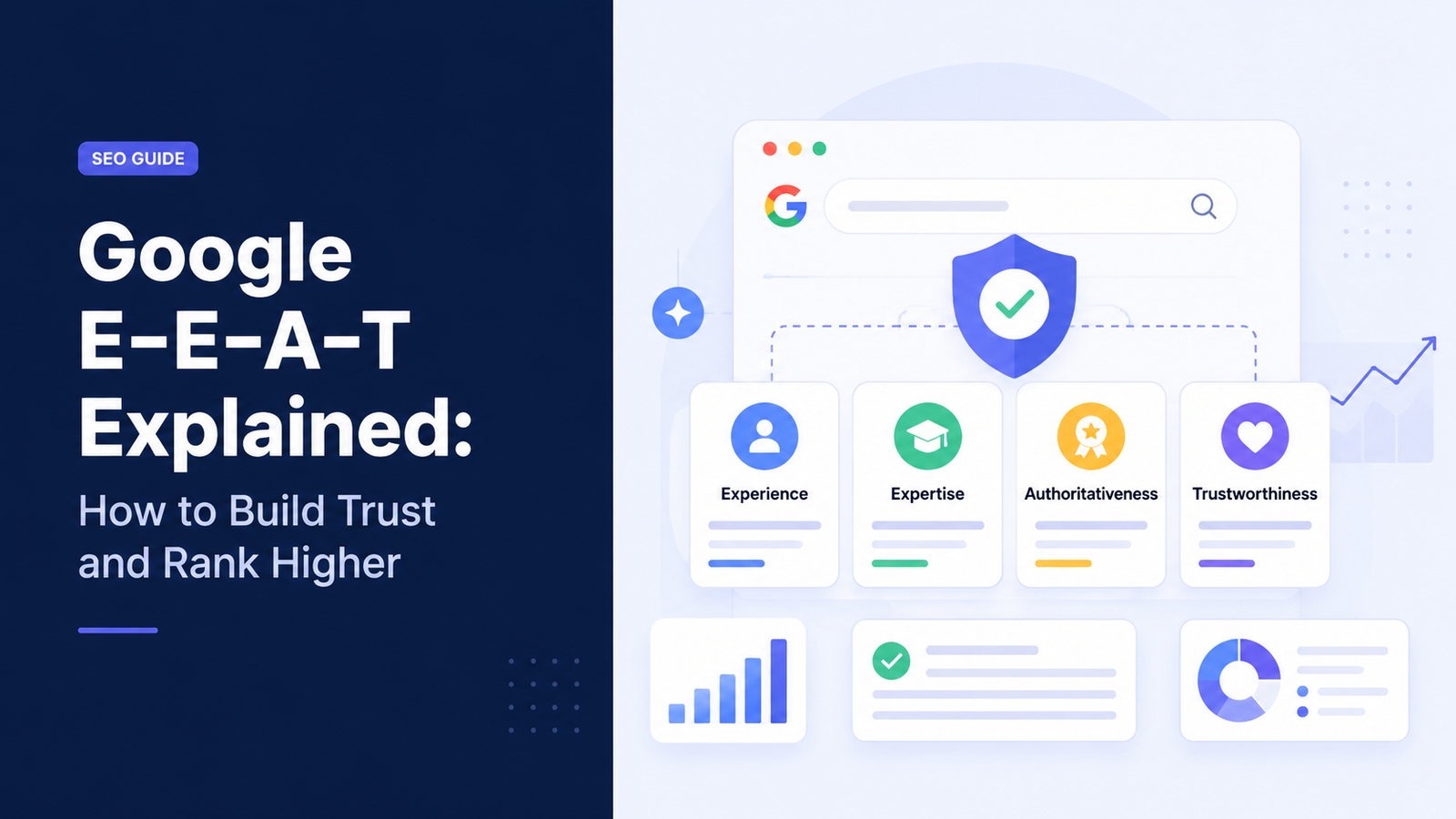
E-E-A-T stands for:
- Experience — Have you actually done this thing, used this product, or lived this situation?
- Expertise — Do you know the subject well, whether through study, training, or years of doing it?
- Authoritativeness — Are other people and sites treating you like a real source on this topic?
- Trustworthiness — Can readers rely on what you’re telling them, and is your site safe and honest?
It’s not a ranking factor you can “install” like a plugin. It’s more like a personality trait your entire website builds up over time, based on hundreds of small signals.
I learned that the hard way.
My Blog Looked Fine. It Wasn’t.
Before the update, my site technically had everything an SEO checklist tells you to have:
- Keyword-optimized titles
- Meta descriptions
- Internal linking
- Fast loading speed (I’d obsessed over this using GTmetrix)
- A decent backlink profile
What it didn’t have was a single sentence about who I was.
No author bio. No photo. No “why should you trust this article” anywhere. I was writing health and fitness content — the kind Google is famously strict about — under a generic username, with zero indication I’d ever set foot in a gym or read a nutrition study.
Looking back, I basically handed Google a reason to be suspicious of my own content.
If you’re publishing on WordPress, my guide on Author SEO in WordPress walks through how to build stronger author trust signals, improve your author pages, and add the right schema markup.
The Fix Wasn’t Complicated, Just Overdue
Here’s what I actually did, in order:
- Added a real “About Me” page explaining my background — I’d been training people casually for three years and had a certification, which I’d never once mentioned on the site.
- Wrote author bios for every post, with a photo, not a stock avatar.
- Linked my social profiles (LinkedIn mainly) so people — and Google — could verify I was a real person.
- Added sources to claims that needed backing up, especially anything medical-adjacent.
- Rewrote thin, generic posts that read like they were summarizing other articles instead of sharing anything I’d personally tested.
None of this was technical SEO. It was closer to being honest about who I was on my own website.
Experience Is the One People Skip Most
Out of the four letters, “Experience” is the one bloggers underestimate the most, probably because it’s the newest addition (Google added the second “E” in December 2022).
Here’s a small example. I wrote two versions of a post about a protein powder brand.
The first version was researched — ingredients, price comparison, general pros and cons. Pretty standard stuff you’d find on twenty other sites.
The second version, written months later, included:
- A photo of the actual tub on my kitchen counter
- How it mixed in a shaker bottle versus a blender
- What it tasted like after two weeks of daily use
- A note about mild bloating I noticed the first few days
The second post outperformed the first by a wide margin, and it wasn’t close. Same topic, similar word count, completely different outcome.
That taught me something simple: Google (and readers) can tell the difference between “I researched this” and “I did this.”
Expertise Doesn’t Mean You Need a PhD
This part actually relieved me once I understood it properly.
Expertise, in Google’s world, is topic-dependent. If you’re writing about something that could hurt someone if the advice is wrong — like medical, legal, or financial topics (Google calls these “Your Money or Your Life” pages) — the bar is high. You genuinely need credentials or a very clear reason to be trusted.
But if you’re writing about, say, board games, budget travel, or home coffee setups, expertise looks different. It’s built through:
- Consistency (you’ve written about this niche for a while, not just once)
- Specificity (you know the small details generic writers miss)
- Correcting yourself publicly when you get something wrong
I once posted an incorrect brewing ratio for a French press recipe. A reader called it out in the comments. Instead of quietly editing it and pretending it never happened, I added a small note: “Update: a reader pointed out my ratio was off — fixed below, thanks for catching that.”
That single line probably did more for trust than any keyword optimization I’ve done.
Authoritativeness: Nobody Believes You Just Because You Say So
This one stung a bit to accept.
You can call yourself an expert all day long. It means nothing unless other corners of the internet treat you like one.
Here’s what actually moved the needle for me:
- Getting a guest post published on a niche site with real readership
- Being mentioned (even briefly) in a roundup article by someone else
- Answering questions on Reddit and Quora in my niche, with my blog linked in context, not spammed
- Building a small but real email list, which signals ongoing reader trust over time
None of these happened overnight. The guest post alone took four rejected pitches before one editor said yes.
I’d compare it to being the “new person” at a job. Nobody trusts your opinion in week one, no matter how qualified you are on paper. Trust gets built through other people vouching for you, one interaction at a time.
Trustworthiness Is the Boring, Unsexy One — And the Most Important
If Experience and Expertise are about the writer, Trustworthiness is about the website itself.
Google’s guidelines (and honestly, common sense) look at things like:
- Is there an easy way to contact you? (A working contact page, not a broken form)
- Is there a privacy policy, especially if you’re running ads or collecting emails?
- Are there way too many pop-ups, redirects, or clickbait elements that annoy visitors?
- Does the site have HTTPS?
- Are the claims backed by anything, or is it just opinion presented as fact?
I once audited a friend’s blog that was struggling in rankings, and the contact page literally 404’d. There was no privacy policy despite running Google AdSense, which technically isn’t even compliant with AdSense’s own program policies. We fixed both in an afternoon, and while it wasn’t a magic traffic bump overnight, it removed what was likely acting as a silent red flag.
A Quick Trust Checklist I Now Run On Every Site I Manage
- Contact page works and has a real email
- Privacy policy and (if monetized) an ads/affiliate disclosure
- Author bio visible on every post, not buried
- HTTPS enabled
- No misleading headlines that the content doesn’t actually deliver on
- Sources linked for statistics or medical/financial claims
I run through this list using a simple site crawl in Screaming Frog (free version handles small blogs fine) plus a manual click-through, and it takes maybe twenty minutes.
Tools That Actually Helped Me With This
I’m not going to pretend E-E-A-T is something you can “check” with a single tool, because it isn’t. But a few things made the process easier:
- Google Search Console — to see which pages lost or gained traffic after updates, so I knew where to focus first.
- Grammarly — not for SEO directly, but sloppy writing quietly damages trust signals too.
- Ahrefs’ free backlink checker — to see who was already linking to me, which helped when reaching out for guest posts.
- Yoast SEO / Rank Math — mainly for the schema markup options, which let me mark up author info properly so Google can actually read it, not just see it.
- Canva — sounds unrelated, but a proper author photo and simple graphics made the site feel more like a real, run-by-a-person operation instead of a content farm.
What I’d Tell Someone Starting a Blog Today
If I were starting from zero again, knowing what I know now, here’s the order I’d do things in:
- Pick a niche you actually have some real connection to. Faking experience is exhausting and Google’s updates keep getting better at spotting it anyway.
- Set up your About page and author bio before your tenth post, not your hundredth.
- Write your first few posts slower, with real specifics, instead of publishing fast and thin.
- Get one genuine external mention — a guest post, a forum answer, a small collab — before obsessing over keyword volume.
- Keep a “corrections” habit. Being wrong occasionally and owning it publicly builds more trust than pretending to be infallible.
None of this replaces solid keyword research or decent technical SEO. Those still matter. But I’ve noticed that sites lacking E-E-A-T signals tend to plateau even when everything else is technically fine — like a car with a great engine and a flat tire.
A Small Update Since That Bad Morning
My traffic did recover, though not instantly and not fully in one shot. It came back in stages, mostly after I’d rewritten the thinnest posts and added real author information sitewide.
What surprised me more was that newer posts, written with an actual “I tested this” mindset from the start, tended to rank faster than my older content ever did, even without extra backlinks.
That’s really the whole lesson here. E-E-A-T isn’t a trick or a plugin setting. It’s closer to just… showing up as a real person who actually knows what they’re talking about, and letting that show on the page instead of hiding behind generic content.
Slow to build, easy to lose, and honestly, worth it.